
Skip the $7 Cafe Bill: The Ultimate Homemade Matcha Latte Recipe
Let’s be real. Ordering a Matcha latte at a coffee shop feels a little bit like a performance. You try to sound sophisticated while the barista inevitably glares at you for choosing a drink that isn’t coffee. Then you watch them dump three pumps of sugar syrup into your otherwise healthy green tea. What’s the point? I’m here to tell you that you deserve better! You deserve a vibrant, perfectly whisked, and unbelievably creamy Matcha latte right now, in your own kitchen, without the passive aggression or the ridiculous price tag. This recipe is the key to unlocking true matcha magic.
Why This Homemade Matcha Latte Is Your New Morning Ritual
Why bother with a whisk and green powder when you can just grab a coffee? Because this recipe is awesome, that’s why. It delivers that signature smooth, slightly vegetal flavor and the beautiful emerald color that makes a good matcha so satisfying, but you control the quality and the sugar.
First, the flavor is superior. We teach you how to properly whisk the matcha, eliminating those grainy clumps and creating a silky smooth base. Second, it’s ridiculously easy once you nail the three-step process. Third, it’s a serious health upgrade (matcha is packed with antioxidants!). Plus, it’s incredibly cost-effective. Why spend $7 a day when you can make a gourmet version for pennies? You’ll become your own favorite barista, IMO.
Ingredients: The Green Dream Team
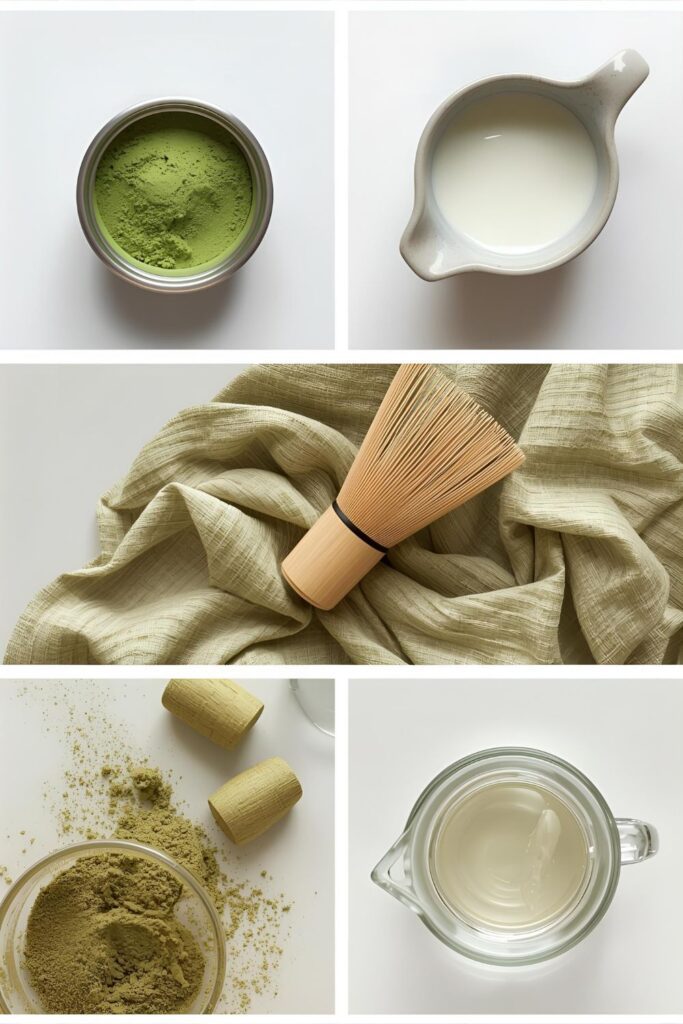

Keep it minimalist. High-quality matcha and good milk are the only non-negotiables.
H3: The Matcha Base
- 1 teaspoon Ceremonial Grade Matcha Powder: Crucial! Culinary grade is fine for baking, but ceremonial grade is best for drinking.
- ¼ cup Hot Water (not boiling): Around $170^{\circ}\text{F}$ ($77^{\circ}\text{C}$). Boiling water burns the matcha, making it taste bitter!
- 1-2 teaspoons Sweetener: Honey, maple syrup, agave, or simple syrup. Adjust to your sweetness preference.
H3: The Creamy Finish
- ¾ cup Milk (or alternative): Whole milk, oat milk, or almond milk are excellent choices. Oat milk is the current champion for frothiness!
- Optional: Vanilla Extract: A tiny dash elevates the flavor.
- Optional: Ice: For an iced version.
Key Substitutions:
- Sweetener Swap: Use liquid stevia or monk fruit drops for a keto-friendly, sugar-free version.
- Milk Swap: Whole milk provides the richest texture for a traditional latte. If going dairy-free, oat milk is the best alternative for achieving velvety microfoam.
- Matcha Grade: If you’re new to matcha, culinary grade works for a cheaper starting point, but the flavor will be slightly earthier and less vibrant.
Tools & Kitchen Gadgets Used: Your Zen Barista Kit
You’ll need a way to whisk the powder, which is the most important step!
- Matcha Bowl (Chawan): A small bowl with a flat bottom is ideal for whisking.
- Bamboo Whisk (Chasen): Highly recommended! Creates the best foam and fully incorporates the powder without clumps. A milk frother or small wire whisk works as a backup.
- Fine Mesh Sieve/Sifter: Mandatory! Matcha clumps easily. Sifting ensures a silky smooth finish.
- Measuring Spoons: For accurate powder and water ratios.
- Small Saucepan or Milk Frother: For warming/steaming the milk.
- Thermometer (Optional): To ensure your water isn’t too hot.
- Spoon or Small Pouring Vessel: For transferring the matcha liquid.
Step-by-Step Instructions: Whisking Your Way to Zen
The secret is starting with a smooth paste and avoiding scalding water. Follow these steps for a clump-free delight.
H3: Step 1: The Sift (No Clumps Allowed!)
Place your fine mesh sieve over your matcha bowl. Add the 1 teaspoon of matcha powder to the sieve. Use the back of a spoon to gently press and sift the matcha into the bowl. This eliminates any tiny clumps and is crucial for a smooth drink.
H3: Step 2: Whisk the Concentrate (The V-Shape Motion)
Add the hot water ($170^{\circ}\text{F}$ / $77^{\circ}\text{C}$) and your sweetener to the sifted matcha. Using your bamboo whisk (Chasen), quickly whisk the mixture in a vigorous “W” or “M” motion (not a circular stir) for about 30 seconds. Whisk until a smooth, frothy layer forms on top and all powder is dissolved. This is your vibrant, concentrated matcha base.
H3: Step 3: Steam the Silk
Heat your milk in a saucepan or using a milk frother until it is steaming, but not boiling. If using an oat or whole milk, froth it slightly to create a beautiful microfoam.
H3: Step 4: The Final Assembly (Hot Latte)
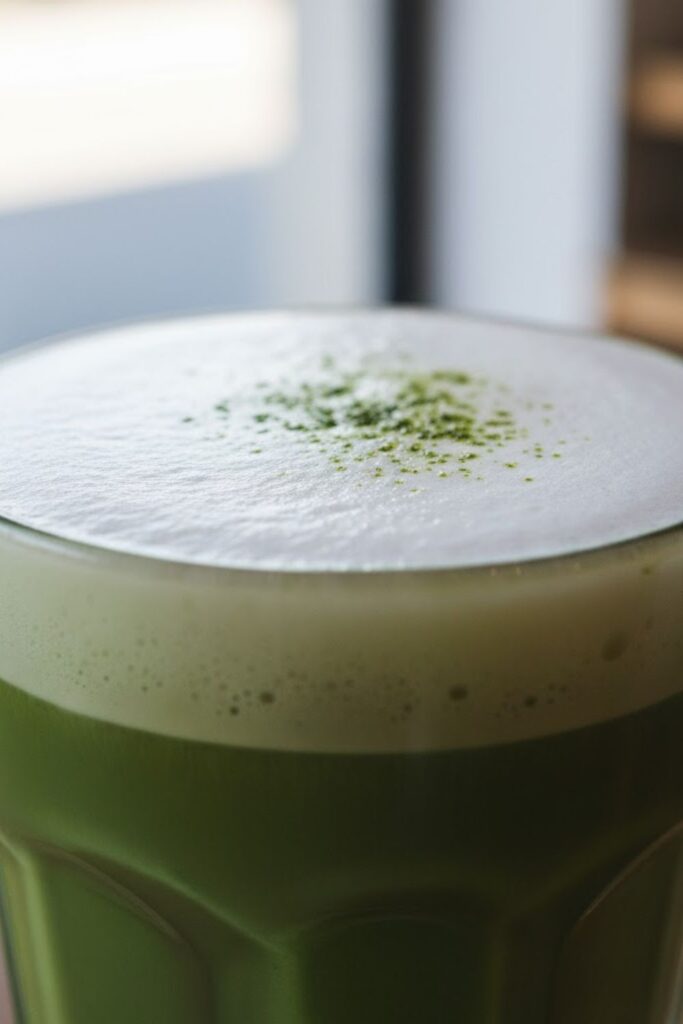
Pour the whisked matcha concentrate into your favorite mug. Add the milk (holding back the foam). Spoon the remaining foam on top. Garnish with a tiny pinch of sifted matcha powder. Serve immediately!
H3: Step 4: The Final Assembly (Iced Latte)
For an iced version, fill a tall glass with ice. Pour the whisked matcha concentrate over the ice. Fill the rest of the glass with cold milk. Stir and enjoy!
Calories & Nutritional Info: The Healthy-ish Sip
Matcha itself is very low-calorie. The final count depends entirely on your milk and sweetener choices. These estimates are approximate per 12-ounce serving.
- Estimated Calories per serving (with oat milk and maple syrup): 120-200 calories
- Fat: 5-10g (from milk/oat milk)
- Carbohydrates: 15-25g (from milk and sweetener)
- Protein: 3-8g
- High in Antioxidants: Matcha is packed with catechins like EGCG. It’s basically a superfood shot!
- Steady Energy: Contains caffeine but also L-theanine, promoting focused calm without the coffee jitters.
- The Bottom Line: A healthy, mindful alternative to sugary coffee drinks.
Common Mistakes to Avoid: Don’t Mess Up the Green Gold!
Matcha preparation is delicate. Avoid these errors for a perfect sip.
- Using Boiling Water: Boiling water ($212^{\circ}\text{F}$ / $100^{\circ}\text{C}$) burns the fine matcha powder, releasing tannins that make the entire drink taste harshly bitter. Use water around $170^{\circ}\text{F}$ ($77^{\circ}\text{C}$)!
- Not Sifting the Powder: Matcha powder is ultra-fine and clumps easily. Skipping the sieve guarantees a grainy, clumpy drink. Sift, always!
- Stirring Instead of Whisking: Stirring doesn’t properly dissolve the powder or create the necessary air bubbles. You must whisk vigorously in the “W” motion to emulsify the powder and water.
- Adding Cold Milk to Hot Matcha: If the milk is fridge-cold and you add it to the hot matcha concentrate, the drink will immediately drop in temperature and feel unbalanced. Use room temperature or warm milk for hot lattes.
Variations & Customizations: Your Matcha Masterpiece
Once you master the base, your flavor options are limitless!
- Iced Keto Vanilla Matcha: Use liquid stevia or monk fruit as the sweetener. Use heavy cream or full-fat coconut milk diluted with water as your base. Add a dash of sugar-free vanilla syrup. Serve over ice.
- Spicy Ginger Matcha: Add a small slice of fresh ginger (about $1/4\text{inch}$) to your water while heating it. Strain the water before whisking the matcha. The warmth of the ginger is fantastic.
- Matcha Cold Brew Fusion: Instead of water, whisk your sifted matcha directly with a small amount of cold milk and sweetener until smooth. Pour this concentrate over ice and top with cold brew coffee for a caffeine-packed, earthy mix.
FAQ Section: Answering Your Green Tea Queries
You’ve got questions about this vibrant green powder. I’ve got the answers.
H3: Q1: What is the difference between ceremonial and culinary grade matcha?
A1: Ceremonial grade uses the youngest, highest quality leaves, is less bitter, and is intended for drinking pure. Culinary grade uses slightly older leaves, is more robust/bitter, and is meant to be mixed into baked goods or smoothies.
H3: Q2: Does matcha have more caffeine than coffee?
A2: Not exactly. Matcha has less caffeine per serving than a standard cup of coffee. However, the caffeine in matcha releases more slowly into your bloodstream due to the L-theanine, giving you a longer, steadier energy boost without the jitters.
H3: Q3: What is the best way to sweeten matcha?
A3: Liquid sweeteners like honey, maple syrup, or simple syrup blend easiest into the warm matcha concentrate. Granulated sugar can be used but requires more vigorous whisking.
H3: Q4: Why does my matcha taste bitter?
A4: Your matcha tastes bitter for two main reasons: you used water that was too hot (boiling) or you used low-quality/old matcha powder. Reduce your water temperature to $170^{\circ}\text{F}$ ($77^{\circ}\text{C}$).
H3: Q5: Can I use a milk frother instead of a bamboo whisk?
A5: Yes! An electric milk frother or a small battery-powered whisk works well to break up clumps and create foam. Just make sure the whisking surface is flat enough to reach all the powder at the bottom of the bowl.
H3: Q6: Is matcha good for you?
A6: Yes! Matcha provides high levels of antioxidants (especially EGCG) and L-theanine, which promotes relaxation and focus. Since you consume the entire tea leaf, you get more nutrients than traditional brewed tea.
H3: Q7: Can I just stir the matcha powder into hot milk?
A7: You can, but you’ll almost certainly end up with a clumpy, grainy result at the bottom of your mug. Whisking the powder with a small amount of water first (creating the concentrate) is the key to a silky smooth latte.
Final Thoughts: Sip Your Way to Serenity!
You did it! You created a gorgeous, perfectly frothed, and unbelievably delicious Matcha latte. Go ahead, take a well-deserved, mindful sip. Isn’t that better than a rushed drive-thru order? I knew it would be. You are now the master of the green gold. Are you ever going back to watery, overly sweet cafe matcha again? I highly doubt it. Enjoy your smooth, satisfying serenity!