
Forget Weeks of Waiting: The Ultimate 24-Hour Sauerkraut Recipe
Let’s be honest. When you hear “fermentation,” you probably picture a mad scientist in a basement, bubbling jars, and maybe a 4-week waiting period. Traditional sauerkraut is amazing, but who has a month to wait for the perfect crunchy, tangy topping for their bratwurst? Nobody, that’s who. Well, the waiting game is over! I’m here to tell you that you can achieve a delightful, crisp, and incredibly healthy version with this game-changing 24-hour sauerkraut recipe. It’s got all the zing and crunch you crave, ready for your face by tomorrow. Get ready for instant gratification!
Why This 24-Hour Sauerkraut is Your New Favorite Hack
Why settle for store-bought sauerkraut when you can make a super fresh batch almost instantly? Because this recipe is awesome, that’s why. It delivers that signature tangy, sour flavor and that essential loud crunch without the deep, sometimes overpowering flavor of long fermentation.
First, it’s ridiculously fast. As the name suggests, you get results in 24 hours, not 24 days. Second, it’s incredibly simple—just cabbage, salt, and some elbow grease. Seriously, no fancy starters or airlocks required. Third, it’s packed with probiotics (even the quick version!), making it a super healthy addition to any meal. Plus, think of the bragging rights! You casually bring out homemade sauerkraut, and suddenly you’re the most sophisticated person at the BBQ. Who doesn’t want that kind of kitchen superpower?
Ingredients: Cabbage, Salt, and Simple Magic
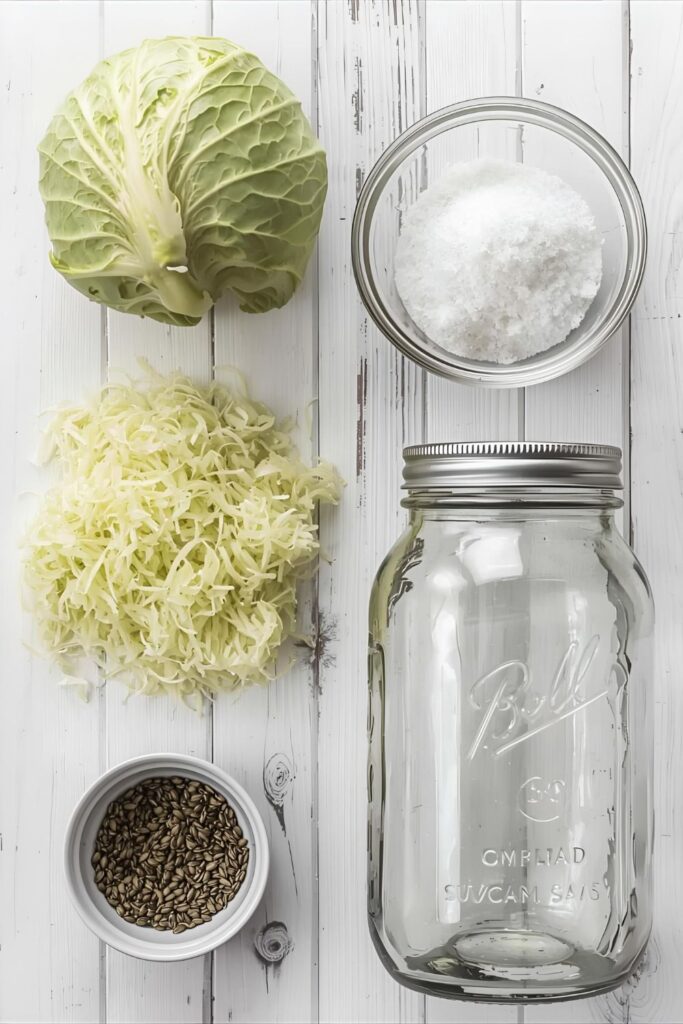

You only need two essential ingredients. The rest is just for flavor customization!
H3: The Core Fermentation Duo
- 1 medium head Green Cabbage (about 3 lbs): Use fresh, firm cabbage. This is non-negotiable!
- 1 ½ tablespoons Kosher Salt: Crucial for drawing out moisture and controlling fermentation! Do NOT use iodized table salt; it inhibits the good bacteria and makes the finished product bitter.
H3: Optional Flavor Boosters
- 1 teaspoon Caraway Seeds: Adds that classic, authentic German sauerkraut flavor.
- ½ teaspoon Black Peppercorns: For a subtle, balanced heat.
- 1-2 Carrots: Grated or finely shredded. Adds color and a touch of sweetness.
- 1 tablespoon Fresh Dill: Finely chopped. For a more herbaceous flavor.
Key Substitutions:
- Cabbage Swap: You must use green cabbage. Red cabbage works for color, but it releases more color, which can make the brine look a little murky. Avoid Napa cabbage, as it’s too soft.
- Salt Swap: Kosher salt or non-iodized sea salt is mandatory. If using fine table salt, use slightly less (about 1 tablespoon) as it is denser.
- Flavoring: Feel free to omit the caraway seeds if you don’t like the flavor, but it is traditional!
Tools & Kitchen Gadgets Used: Your Fermentation Starter Pack
No fancy equipment needed, but you’ll need muscle and a good container!
- Large Cutting Board and Sharp Knife: For thinly slicing the cabbage.
- Mandoline Slicer (Optional, but highly recommended): The secret to fine, uniform shredding! This makes the job fast and easy.
- Extra-Large Mixing Bowl: Essential for massaging the cabbage. You need space to work!
- Quart-size Mason Jar(s) or Fermentation Crock: For packing and submerging the finished mixture. Glass jars are perfect.
- A Weight (Small glass jar, clean rock, or fermentation weights): Crucial for keeping the cabbage submerged beneath the brine.
- Measuring Spoons: For accurate salt measurements.
Step-by-Step Instructions: Sauerkraut in the Fast Lane
This is where the magic (and the massaging) happens. Put some intention into it!
H3: Step 1: Shred the Cabbage (Thin is In)
Remove the outer leaves of the cabbage (save one large leaf!). Quarter the cabbage and cut out the tough core. Shred the cabbage very thinly. Use a mandoline for the fastest, most uniform result, or slice as finely as possible with a sharp knife. Thin shreds release liquid quickly.
H3: Step 2: Salt and Massage (Get Aggressive!)
Place the shredded cabbage (and grated carrots, if using) in your extra-large mixing bowl. Sprinkle the kosher salt evenly over the cabbage. Now, put on some music and get ready to work! Massage, squeeze, and pound the cabbage vigorously with your hands for 5-10 minutes. You are breaking down the cell walls to release liquid. Stop when the cabbage is noticeably wilted, reduced in volume, and you can see a significant pool of brine at the bottom of the bowl.
H3: Step 3: Add the Spices
Once the brine has formed, mix in your caraway seeds, black peppercorns, and any other spices or herbs. Stir thoroughly so they are evenly distributed.
H3: Step 4: Pack the Jar & Submerge (The Compression Test)
Using your fist or a wooden spoon, tightly pack the cabbage mixture into the clean Mason jar(s). Pack it down hard, ensuring the liquid brine rises above the cabbage. Fold the reserved large cabbage leaf and place it on top of the shredded cabbage—this acts as a “lid.”
H3: Step 5: Weight Down the Woes
Place your fermentation weight or a small, clean, heavy object (like a smaller, clean glass jar filled with water) on top of the cabbage leaf. The brine must completely cover the cabbage! This keeps the cabbage safe from air and mold. Loosely cover the jar with the lid (don’t screw it on tightly) or cover with a cheesecloth/coffee filter secured with a rubber band.
H3: Step 6: The Quick Ferment & Chill
Leave the jar at cool room temperature (ideally $68^{\circ}\text{F}$ to $72^{\circ}\text{F}$ / $20^{\circ}\text{C}$ to $22^{\circ}\text{C}$) for 24 hours. You might see small bubbles forming—that’s the good bacteria working! After 24 hours, taste it. It should have a noticeable tang and crunch. If you like the flavor, remove the weight and move the jar to the refrigerator to halt fermentation. If you want it a little more sour, let it sit for another 12-24 hours.
H3: Step 7: Serve & Savor
Your fast, fresh 24-hour sauerkraut is ready! Serve it on Reubens, hot dogs, sausage, or eat it straight from the jar. It stays fresh (and slowly continues to ferment) in the fridge for up to 3 weeks.
Calories & Nutritional Info: The Healthy Crunch
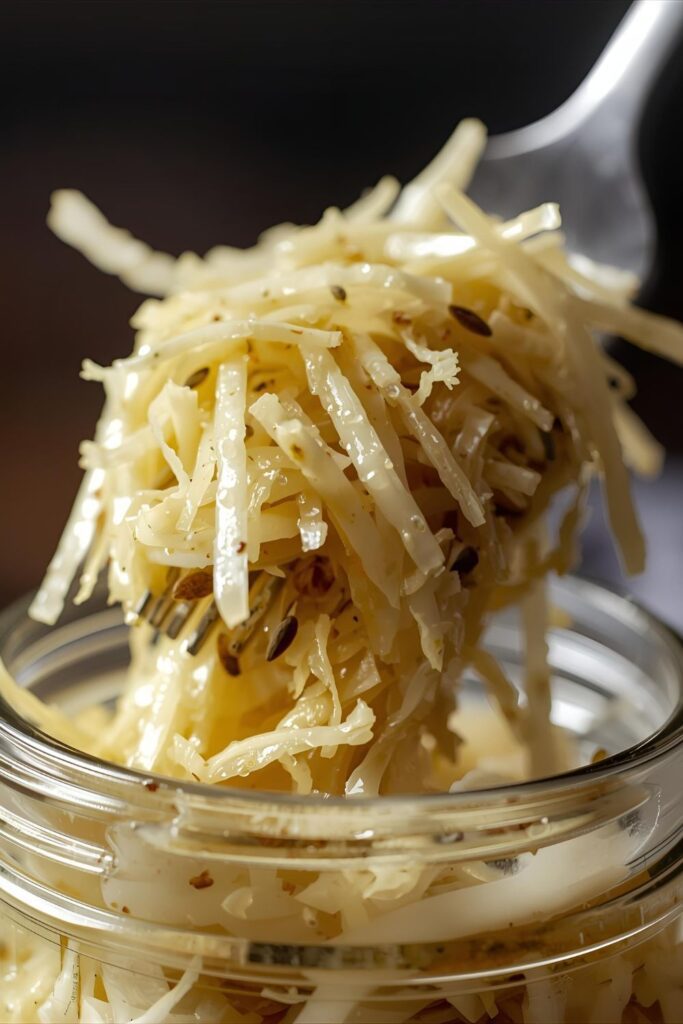
Sauerkraut is a nutrition powerhouse, especially in the probiotic department!1 These estimates are approximate per ½ cup serving.
- Estimated Calories per serving (½ cup): 15-25 calories
- Fat: 0g
- Carbohydrates: 3-5g
- Fiber: 2g (Great for digestion!)
- Sodium: 250-400mg (It’s preserved with salt, so it’s high.)
- Probiotics: Contains live and active cultures. Hello, happy gut!
- Vitamins/Minerals: Rich in Vitamin C and K.
- The Bottom Line: A crunchy, healthy condiment that’s practically guilt-free.
Common Mistakes to Avoid: Stop Fermenting Failures!
Quick fermentation is easy, but you must respect the process (and the salt).
- Using the Wrong Salt: NEVER use iodized table salt. It ruins the fermentation. Kosher salt or non-iodized sea salt only!
- Not Massaging Enough: If you don’t massage the cabbage until a brine forms, the mixture will dry out and won’t ferment properly. Massage until you see a noticeable puddle of liquid!
- Not Submerging the Cabbage: If cabbage floats above the brine, it is exposed to air and risks developing mold (the dreaded fuzzy white stuff). The brine must cover the cabbage completely; use a weight if necessary.
- Screwing the Lid On Too Tight: Fermentation releases gases (burping!). The lid must be loose (or vented with an airlock/cheesecloth) to allow gases to escape, preventing the jar from building pressure and potentially exploding.
- Heat Too High: High temperatures can kill the beneficial bacteria and cause the cabbage to spoil.2 Keep the jar at a cool room temperature, away from direct sunlight or heat sources.
Variations & Customizations: Your Sauerkraut Canvas
The simple cabbage and salt method is the base. Now, feel free to remix the flavor!
- Spicy Ferment: Add 1-2 teaspoons of gochugaru (Korean chili flakes) or a few thin slices of jalapeño when mixing in the spices. The heat adds a wonderful dimension to the tang.
- Ginger & Turmeric Fusion: Add 1 tablespoon of grated fresh ginger and 1 teaspoon of ground turmeric to the mixture before packing. This creates a beautifully colored, anti-inflammatory powerhouse.
- Apple & Onion Sauerkraut: Add ½ cup of grated green apple (Granny Smith) and ½ cup of thinly sliced yellow onion along with the cabbage. The fruit sweetness adds a great balance to the sour fermentation.
FAQ Section: Your Most Pressing Fermentation Queries
You’re taking the plunge into fermentation. Let’s answer those burning questions!
H3: Q1: Is 24-hour sauerkraut actually fermented?
A1: Yes! Even after 24 hours, the naturally occurring Lactobacillus bacteria on the cabbage begins the fermentation process, creating lactic acid, which gives it the sour flavor and probiotic benefits. It’s just a young, lightly fermented version.
H3: Q2: Does this quick sauerkraut have probiotics?
A2: Absolutely! The fermentation process starts almost immediately. The tangier it gets, the more probiotics it generally contains, but even after 24 hours, it has beneficial live cultures.
H3: Q3: How do I store 24-hour sauerkraut?
A3: After you achieve your desired level of tanginess, transfer the jar to the refrigerator. The cold temperature slows the fermentation process drastically. Store it tightly sealed in the fridge for up to 3 weeks.
H3: Q4: Why is my sauerkraut not sour enough?
A4: The temperature might be too low, or it hasn’t fermented long enough. If the temperature is okay ($68^{\circ}\text{F}$ to $72^{\circ}\text{F}$), let it sit on the counter for another 12-24 hours, tasting every 12 hours until it reaches your preferred sourness.
H3: Q5: Can I make this without caraway seeds?
A5: Yes, you can. While caraway seeds provide the authentic, classic German flavor, you can omit them or replace them with dill seeds or fennel seeds for a different, but still delicious, flavor profile.
H3: Q6: What is the best way to get enough brine from the cabbage?
A6: Use fresh, firm cabbage and ensure you massage the salt in vigorously for a full 5-10 minutes. If, after packing, the cabbage is still not covered, you can add a simple supplemental brine (1 cup water, 1 teaspoon salt, boiled and cooled).
H3: Q7: What are the best foods to eat with sauerkraut?
A7: Sauerkraut is perfect with Reuben sandwiches, bratwurst, hot dogs, corned beef, pork, or even on top of scrambled eggs.3 Its tanginess cuts through rich, fatty foods beautifully.
Final Thoughts: You Are Now a Fermentation Fanatic!
You did it! You’ve conquered the intimidating world of fermentation with this glorious 24-hour sauerkraut. Go ahead, grab a piece and take a bite. Doesn’t that crisp, tangy crunch taste exactly like victory? I knew it would. You’re officially a fast-fermenter. Are you ever going to spend weeks waiting for traditional sauerkraut again? I highly doubt it. Enjoy your crunchy, healthy, and incredibly fast homemade creation!